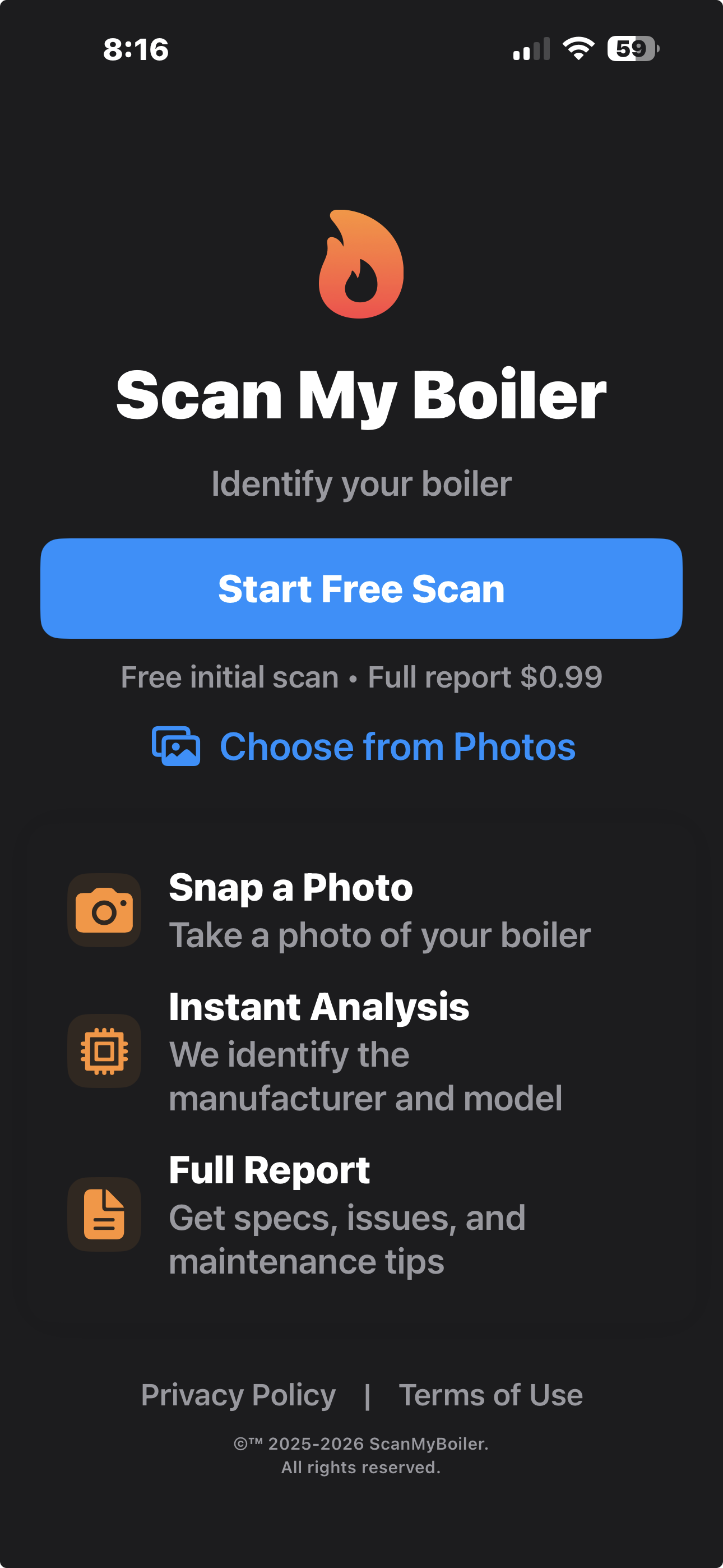
Snap a photo of any boiler and receive manufacturer details, specifications, common issues, and maintenance recommendations.
Free to scan. Full reports just $0.99
Whether you're a building superintendent, property manager, or homeowner, Scan My Boiler gives you the information you need.
Photograph any steam or hot water boiler and receive immediate identification. Get manufacturer, model, and type information in seconds.
Access detailed BTU ratings, efficiency percentages (AFUE), input/output capacity, and production year ranges for your specific boiler model.
Learn about known problems and failure points specific to your boiler model. Stay ahead of potential issues before they become emergencies.
Receive model-specific maintenance recommendations to extend your boiler's lifespan and maintain peak efficiency throughout the heating season.
Trusted by superintendents, property managers, and HVAC technicians across NYC, Chicago, and beyond. Quick identification for any building.
Understanding the different types of boilers and heating systems
Steam boilers heat water to create steam, which rises through pipes to radiators throughout the building. Common in older apartment buildings and commercial spaces. They operate at higher temperatures and require specific maintenance protocols.
Also called hydronic systems, hot water boilers circulate heated water through pipes to radiators or baseboard heaters. More efficient than steam systems and provide more even heat distribution throughout the space.
Natural gas boilers are the most common type in urban areas. They offer clean combustion, high efficiency ratings (up to 98% AFUE with condensing models), and lower operating costs compared to oil-fired alternatives.
Oil boilers are reliable workhorses found in areas without natural gas service. They require on-site fuel storage and regular tank maintenance. Modern oil boilers achieve efficiency ratings of 85-90% AFUE.
Electric boilers use heating elements to warm water. They're compact, quiet, and require no venting. While 100% efficient at point of use, operating costs depend on local electricity rates.
Annual Fuel Utilization Efficiency (AFUE) measures how much fuel is converted to heat. Standard boilers achieve 80-84% AFUE, while high-efficiency condensing boilers reach 90-98% AFUE, reducing fuel costs significantly.
Common questions about boiler identification and maintenance
The rating plate (also called nameplate or data tag) is typically located on the front or side of the boiler jacket. It's a metal plate containing the manufacturer name, model number, serial number, BTU rating, and other specifications. For best results with Scan My Boiler, photograph this plate clearly.
The free scan provides basic identification including manufacturer, model name or series, boiler type (steam/hot water), and fuel type. This is helpful for quick identification when scheduling service calls or ordering parts.
The full report includes complete BTU specifications, efficiency ratings (AFUE), production year range, known issues for your specific model, and detailed maintenance recommendations.
Boilers should be professionally serviced annually, ideally before the heating season begins. This includes cleaning, safety checks, and efficiency testing. Buildings with steam systems may require more frequent low water cutoff testing and blowdowns.
Scan My Boiler identifies all major manufacturers including Weil-McLain, Burnham, Peerless, Slant/Fin, Crown, Buderus, Viessmann, Lochinvar, Laars, HTP, Navien, Rinnai, Bosch, Utica, New Yorker, Williamson, Triangle Tube, NTI, Smith Cast Iron, and many more.
Steam boilers heat water until it becomes steam, which rises naturally through pipes to radiators. Hot water (hydronic) systems circulate heated water through pipes using a pump. Steam systems are common in older buildings and require different maintenance than hot water systems.
Signs your boiler may need replacement include: age over 15-20 years, frequent repairs, uneven heating, rising fuel costs, visible corrosion, unusual noises, or difficulty finding replacement parts. Our full report includes model-specific information about common end-of-life indicators.
Yes! Scan My Boiler works with both residential and commercial boilers. Building superintendents and property managers across NYC, Chicago, New Jersey, and other major cities use our service to quickly identify and document building heating equipment.
Get boiler information in three simple steps
Snap a picture of your boiler or its rating plate using your iPhone camera or choose an existing photo from your library.
The image is analyzed to identify the manufacturer, model, and type of boiler.
Receive a free identification summary or unlock the full report with specs, issues, and maintenance tips for $0.99.
Start scanning for free. Pay only when you need the full details.
Download Scan My Boiler now and get the information you need in seconds.